


Pathways to Becoming an NDIS Behaviour Support Practitioner in Australia
This article is for individuals who would like to understand the pathway to becoming an NDIS Behaviour Support Practitioner in Australia.
We explain the New Entry-Level Pathway, also known as the Alternative Assessment Pathway, and how this links to the Self-Assessment.
What are the pathways to becoming an NDIS Behaviour Support Practitioner?
In Australia, NDIS Positive Behaviour Support services provided to NDIS participants are regulated by the NDIS Quality and Safeguards Commission (NQSC).
Before prospective behaviour support practitioners can commence work in behaviour support, they must be approved by the NDIS Quality and Safeguards Commission (NQSC). The NQSC refers to this approval as “suitability”. When the NQSC deems a practitioner as “suitable” they issue the practitioner with a Practitioner ID.
Unless you have previous experience in the field, there is one main pathway to becoming an NDIS Behaviour Support Practitioner in Australia, known as the New Entry-Level Pathway.
New Entry‑Level vs Self-Assessment
The NDIS states that the New Entry-Level Pathway is for prospective, new practitioners, as well as practitioners with less than six months experience and/or practitioners who have limited portfolio evidence. As such, most new practitioners will use this pathway.
Another way that individuals can become a PBS practitioner is via the Self-Assessment application, however, for most, this isn’t practical since you need a portfolio of evidence for the Self-Assessment. This evidence is typically gathered through working as a behaviour support practitioner, which requires a Practitioner ID. In specific cases, such as for those with prior relevant experience, Self-Asessment may still be an option.
The New Entry‑Level Pathway (Alternative Assessment Pathway)
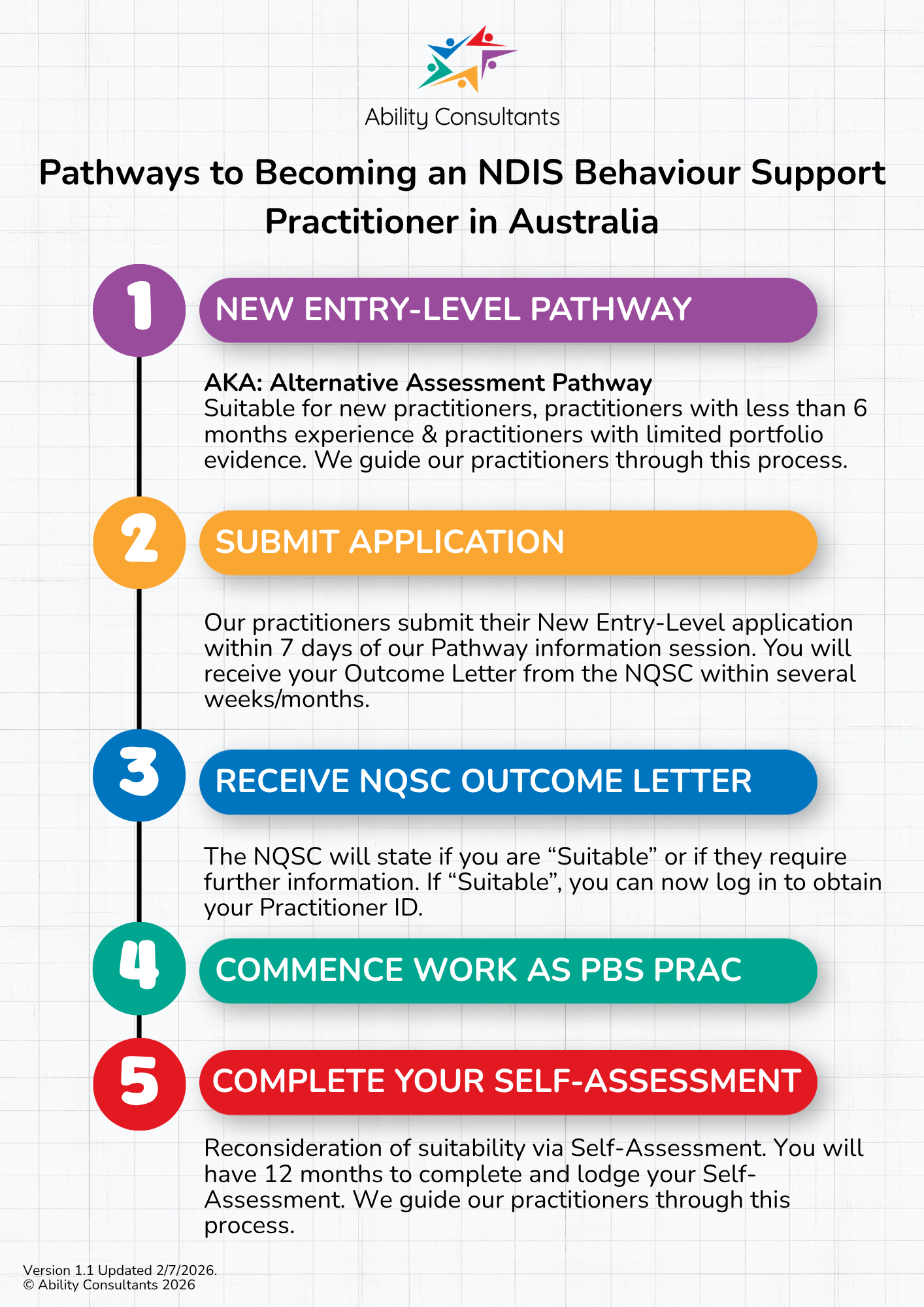
We help our new behaviour support practitioners apply for Suitability through the New Entry-Level Pathway, AKA the Alternative Assessment Pathway.
Who this is for and typical journey
The Alternative Assessment Pathway is designed for practitioners who are just starting out, and therefore do not have a portfolio of evidence. This process enables them to be assessed for suitability and begin to develop their skills whilst collecting evidence under the supervision of a proficient behavior support practitioner.
If you are new to behaviour support, you can apply for suitability status through the Alternative Assessment Pathway. You must be engaged with a Registered Provider, such as Ability Consultants, and maintain regular supervision with a practitioner who is at the Proficient level or above (more about supervision below).
At Ability Consultants, our new practitioners are supported through this process by our Clinical Orientation and Induction Manager, who hosts an information session and provides a detailed checklist explaining key steps in the Alternative Assessment.
Our practitioners submit their Alternative Assessment application within 7 days of the information session.
What happens after you apply
Once you have submitted your application for Suitability, it can take several weeks or months to receive your Outcome Letter from the NQSC.
Your Outcome Letter will state that you are Suitable, or they will request further information.
If you are approved as Suitable, you will also be provided with instructions on how to access your Outcome Letter by downloading if from the NQSC’s portal. Being confirmed as Suitable and receiving your Outcome Letter (which includes your Practitioner ID) is required before commencing work as an NDIS Behaviour Support Practitioner in Australia.
Self‑Assessment
When you complete the Alternative Assessment application, you sign a declaration form stating that you understand you must compile a portfolio of evidence and acknowledge that your suitability will be reconsidered by the NQSC in 12 months. In this reconsideration process, practitioners lodge a Self-Assessment.
At Ability Consultants, we support and guide our practitioners through the Self-Assessment application process.
Eligibility and required evidence
The Self-Assessment involves completing a Portfolio of Evidence. This Portfolio of Evidence needs to align with each of the seven domains in the NQSC PBS Capability Framework. The Portfolio of Evidence allows your Team Leader (supervisor) to certify the capabilities on your Self-Assessment in order to complete the endorsement tool.
The Self-Assessment Pathway also involves submitting:
- de-identified work samples
- a Self-Assessment completed by both you and your supervisor
- a current Learning and Development Plan (Professional Development Plan)
- evidence of participation in regular supervision and mentoring
- an Endorsement tool
- resume/CV
- certified copies of qualifications and course certificates
What happens after you lodge your Self-Assessment?
After you lodge your Self-Assessment, the NQSC reviews your application. Your outcome letter will specify your suitability status, and if you opted in to feedback, you will receive feedback in your outcome letter. The NQSC does not certify that your skillset is at a particular level of the Capability Framework, just that you are Suitable to continue working as a Behaviour Support Practitioner.
Formal supervision is essential
The NDIS Quality Indicators require that all Behaviour Support Practitioners supporting NDIS participants are supported/overseen by a supervisor who is at the proficient practitioner level or above.
In their Position Statement about Clinical Decision Making, Behaviour Support Practitioners Australia (BSPA) stated that “BSPA considers access to appropriate clinical supervision to be a core safeguard within behaviour support practice. Clinical supervisors should support practitioners to critically analyse the issue, consider relevant legislation and frameworks, and arrive at a reasoned and defensible course of action.”
The role of your supervisor is to provide clinical guidance and support to develop your skills and knowledge across the seven domains of the NQSC PBS Capability Framework. You will sign a declaration form and provide a copy of a supervision agreement outlining that you agree to participate in regular supervision.
Who can be a clinical supervisor
Individuals who apply for Suitability through the Alternative Assessment Pathway must be supervised by an NDIS Behaviour Support Practitioner who is Proficient level or above (Proficient or Advanced/Specialist).
Methods of supervision
The method of supervision will depend on the needs of the practitioner. Options include 1:1 support, peer supervision, group supervision, mentoring or coaching. At Ability Consultants, all practitioners engage with their own Team Leader (supervisor/mentor) through weekly 1:1 support, and practitioners are also invited to fortnightly peer supervision, group learning sessions and mentoring/supervision in any other area needed for their role.
How we support you with the application process
We support our behaviour support practitioners with their Alternative Assessment and Self-Assessment throughout their career at Ability Consultants.
Application guidance
We help you gather evidence, complete and submit your application by providing:
- step-by-step application guides;
- templates for your application (resume, supervision agreement, professional development plan);
- templates to ensure your documented evidence aligns with best-practice
- weekly clinical supervision and ongoing professional development support
- free online and real-time training to help you develop skills in each of the Capability Framework domains; and
- a dedicated specialist to provide guidance right from the start.
Clinical supervision
We provide you with a qualified supervisor:
- Every behaviour support practitioner is assigned a Team Leader, described by the NQSC as your clinical supervisor.
- We ensure Team Leaders are qualified and equipped for their role through a formal selection process, training, clinical supervision, ongoing mentoring, learning and development.
- We ensure every practitioner and their Team Leader define and sign a Supervision Agreement, which we refer to as your Mentoring Agreement. Together, you will define meeting frequency and location as well as how often you will meet, how, where, and preferred feedback and communication styles.
- As a member of our team, you do not pay a fee to be supported by a qualified supervisor. If you do not work at Ability Consultants and choose to engage an external supervisor, you may be required to pay your supervisor a monthly fee. We do not charge this fee.
Further your career with Ability Consultants
Our mission is to create more freedom and social connection for people with disability. One way we do this is by building the next generation of PBS leaders by supporting them through the Alternative Assessment Pathway and Self-Assessment.
To join our team as a Behaviour Support Practitioner, contact us at [email protected]. You can also find more information about PBS careers here on our website.
Frequently Asked Questions
What do I need before I start work as an NDIS Behaviour Support Practitioner?
The NDIS Quality and Safeguards Commission must provide you with confirmation that you are “Suitable”.
How long does it take to obtain Suitability?
It can take several weeks or months to receive an outcome on your suitability application.
Can I work as an NDIS PBS Practitioner before I have been approved as “Suitable”?
No, you can not work as an NDIS PBS practitioner until you have been deemed Suitable by the NDIS Quality and Safeguards Commission.
Which pathway is for new or less experienced behaviour support practitioners?
The New Entry-Level Pathway, also known as the Alternative Assessment Pathway.
Can Ability Consultants help me obtain “Suitability”?
Yes! We help all new practitioners at Ability Consultants obtain “Suitability”. We’re here to make the process smoother for you. From answering your individual questions and reviewing your documentation to assisting with any information requests received from NQSC, we have the tools, and a dedicated person available to guide you one-on-one. If challenges come up, we’ll support you every step of the way.
What other support can I expect from Ability Consultants as a PBS practitioner?
We've got a detailed list here, where we outline support including Clinical Supervision, training, access to in-house experts, templates, step-by-step guides and more.
Contributors
Written and reviewed by Nikki Mahayni Cert IV (Community Services), Behaviour Support Practitioner and Manager, Clinical Orientation and Induction
With five years experience guiding our behaviour support practitioners through the NDIS PBS Capability Framework, Nikki offers new and experienced practitioners at Ability Consultants a strong foundation built on clarity, expertise and industry best practice. Nikki has over 10 years experience in the disability and mental health sector. She is passionate about improving quality of life, promoting social inclusion, and helping people live as independently as possible.
Written and reviewed by Melody Dexter BCom, MWriting, Digital Content Manager
Melody has over five years of experience in the disability sector, developing and producing information to support behaviour support practitioners and the people they support.
Reviewed by Steve Davies MSpPath, CPSP, Member BSPA, Member BILD, Member AGOSCI, Advanced/Specialist Behaviour Support Practitioner and Clinical Operations Manager
Steve's career is underpinned by his passion to assist people with disabilities to overcome barriers to their best quality of life. Steve is driven to make PBS accessible to everyone, and build collaborative teams around each individual.
Further reading:
- BSPA, 2026, ‘BSPA Position Statement: Clinical Decision-Making, Legislative Interpretation, and Professional Support Pathways for Behaviour Support Practitioners’, Behaviour Support Practitioners Australia, viewed 4 June 2026.
- BSPA, 2026, ‘How to become a behaviour support practitioner’, Behaviour Support Practitioners Australia, viewed 4 June 2026.
- NQSC, 2025, ‘Self-Assessment Resource Guide’, NDIS Quality and Safeguards Commission, viewed 3 June 2026.
- NQSC, 2026, ‘Apply to become an NDIS behaviour support practitioner’, NDIS Quality and Safeguards Commission, viewed 3 June 2026.
- NQSC, 2026, ‘New behaviour support practitioners: Apply for suitability’, NDIS Quality and Safeguards Commission, viewed 3 June 2026.

 Virtual
  In-person