


Positive Behaviour Support In Central West NSW: Q&A with Behaviour Support Practitioner Nicole Jackson

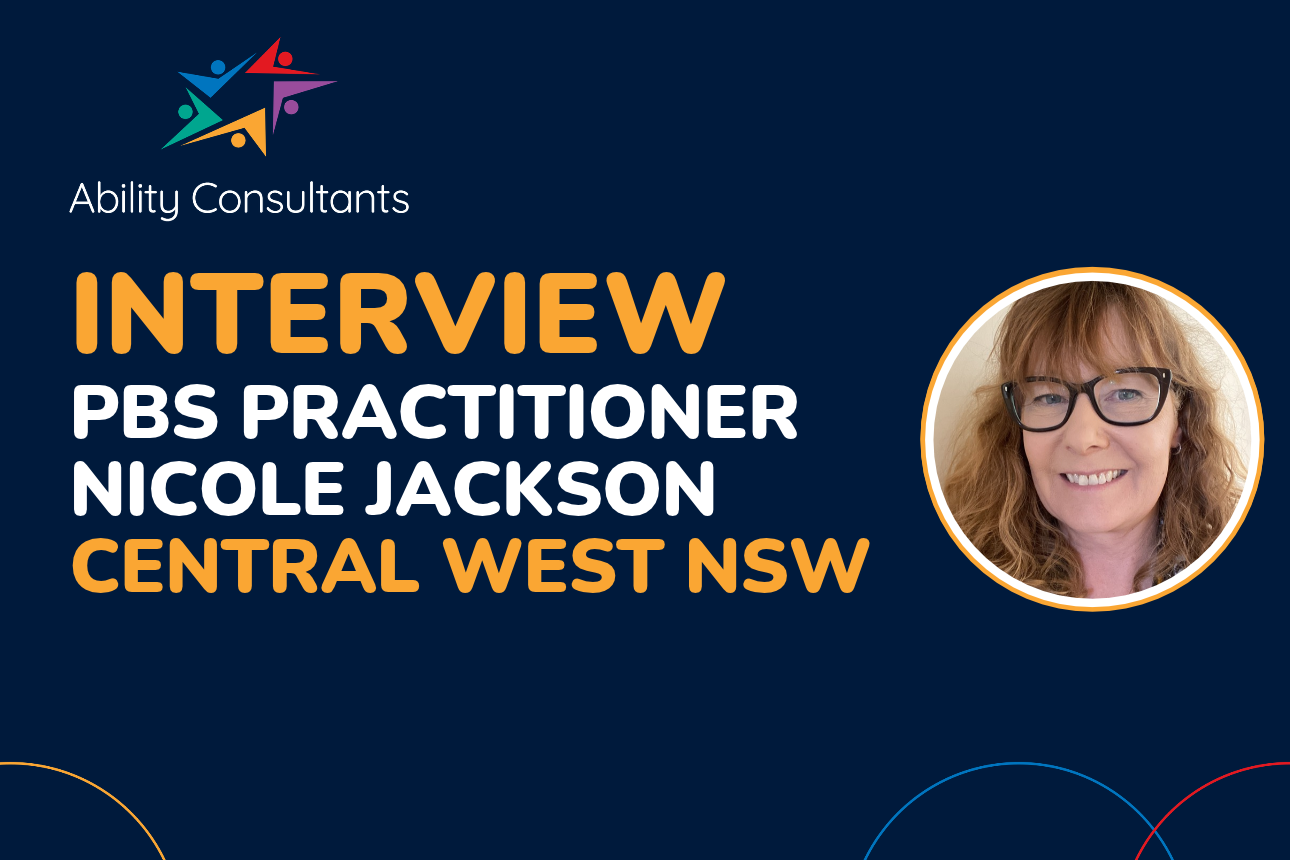
Meet Nicole Jackson, a Positive Behaviour Support Practitioner in Central West NSW with more than 30 years’ experience supporting people with disability.
In this interview, Nicole shares how she places the people she supports at the centre of decisions about their lives.
With a Master of Health Science and multiple counselling qualifications, she brings deep experience to her role as a behaviour support practitioner, helping people improve their quality of life and achieve positive, meaningful outcomes.
Read on to learn more about Nicole’s approach to Positive Behaviour Support (PBS) in Central West NSW.
Meet Nicole Jackson, Behaviour Support Practitioner in Central West NSW
Nicole, tell us about you!
Hi everyone! My name is Nicole and I am a Behaviour Support Practitioner in beautiful Mudgee in the Central West of NSW.
I am passionate about working alongside people with disabilities and have done so for over 30 years. This means I usually have a few “hats” on at any one time — as well as behaviour support, I also provide counselling support for people with disability, their families and carers.
When not engaged in the work that I love, I really enjoy bushwalking and spending time in nature, something that is readily accessible in the Mudgee region!
Tell us about your work in Positive Behaviour Support.
I started in Positive Behaviour Support with a PBS course through Flinders University in 2020. This course really opened my eyes to the possibility of becoming a Behaviour Support Practitioner and being able to utilise my years of experience of working alongside people with disability in order to further support individuals with PBS in a truly person centred way.
I originally started working as a practitioner with Ability Consultants in April 2020, and with the support of a knowledgeable team, I was able to hone my skills to provide behaviour support that aimed to improve people's quality of life in the least restrictive way. Having had a break from the role for a few years, I look forward to providing behaviour support that is best practice and centred around the people who need support.
Tell us about your qualifications and how these influence your approach to Positive Behaviour Support.
My qualifications include Master of Health Science (Developmental Disability), Diploma and Graduate Certificate in Counselling and a Graduate Certificate in Community Management. My qualifications and experience working in the disability sector have provided me with valuable insight into the unique and individual needs of not only the individuals who require behaviour support but also their families and supporters.
I was really fortunate to have received training in Person Centred Thinking Tools and I use these regularly in my behaviour support work. These tools help me gain a greater understanding of what is important to the person I am supporting and how they can be best supported. My counselling qualifications and experience are also incredibly helpful and enable me to work with individuals using patience, empathy and active listening skills.

You have supported people with disability for over 30 years. What are some key lessons you’ve learnt?
- All behaviour is communication — not everyone with a disability communicates verbally or with words. I have learnt that in order to understand someone’s unique communication style we sometimes need to “listen” differently, by observing what the person is telling us through their actions and taking time to understand what their distinctive communication style is.
- Everyone is unique — regardless of what a person’s formal diagnosis is, all people have different needs, goals and desires. To better understand people as individuals in their own right, I have used Person Centered Thinking tools to place the person at the centre of decision making and choice and also to help their supporters provide support that best suits their needs.
- We all have dreams and aspirations — over the years I have worked alongside people who have done amazing things and also individuals who have needed additional support to obtain their desired goals, including helping their supporters to better understand the concept of duty of care versus dignity of risk. I feel it is important to listen to the person and to act honestly in response to what they are telling us, not to dismiss hopes and dreams, but to promise to search and investigate if there is a way to make them happen.
NDIS Positive Behaviour Support in Central West NSW
How can Positive Behaviour Support help people with disability in Central West NSW?
Being a regional area, it can be difficult to find the support you need, in particular when it comes to specialised and/or allied health supports. Many people with disability may have a budget for Positive Behaviour Support in their NDIS plan, however are unable to utilise it as they don’t have access to a practitioner.
Having Positive Behaviour Support available in Central West NSW can help individuals in a variety of ways. For example, a teen with mild intellectual disability who is suspended from school. She may require behaviour support to develop strategies for her, her family and the school to assist her with emotional regulation techniques so she can return to school safely and with dignity as it is the only public school in the area.

What can locals expect from you as their behaviour support practitioner?
Locals in Central West NSW can expect an on-site behaviour support practitioner providing face-to-face support across all relevant environments the person attends. Due to a lack of PBS services in the regions, many people have only experienced telehealth PBS. Whilst this is a legitimate form of behaviour support, for some, having a clinician available to meet in person can help build relationships, rapport and trust more readily.
My first step is to make initial contact by phone to set up a first meeting. This meeting is a chance to talk about their concerns, identify any risks or safety issues and to provide an overview of what Positive Behaviour Support is and how it would be delivered. I would focus on trying to understand what is important to the person and their family and how they can be best supported to improve their overall quality of life.
Through evidence based practice and assessments, as a team we will determine what the likely function of a behaviour is and put strategies in place to support the person to use a more functional way to communicate their needs.

What happens once you’ve conducted assessments and written a person’s PBS plan?
I like to consider a PBS Plan as a living document which aims to describe what the person is trying to communicate through their behaviour and what strategies can be used to support the person to communicate their needs and wants in a more functional way that improves their overall quality of life.
All people implementing strategies who are written into a PBS plan will be trained and all strategies will be monitored and reviewed to evaluate their effectiveness. Regular feedback is always sought and welcome in relation to how strategies are working or not working, including feedback from the person. I consider a PBS Plan a collaborative partnership between the person, their supporters and myself focussing on skill building, relationships, quality of life and addressing individual needs.
Can you tell us what steps you take to evaluate if a person’s PBS plan has been effective?
The first thing that might be noticed is that a person’s behaviour of concern has reduced or is no longer happening and that the strategies being implemented are working well.
I would also check in with the family and support team to discuss any other positive impacts of the PBS plan that may be different such as an improvement in the person’s quality of life, if the person has developed new skills, if there are less restrictions in the person's life or if there are less incidents happening across different environments.
It is important to note that strategies and approaches may not be effective forever and may need review and modification, so continuing to work closely with the person and their support team can help to ensure continued success over time.
Who can you support as a behaviour support practitioner in Mudgee?
As a clinician who has worked alongside people with disability for many years and with individuals at different life stages, I support people aged 7 to 65.
To find out more about NDIS Positive Behaviour Support in Mudgee, please feel welcome to make a referral for Positive Behaviour Support on our website.
Positive Behaviour Support Central West NSW: Frequently Asked Questions
How do I know if my NDIS Plan includes funding for behaviour support?
If you need NDIS Positive Behaviour Support in Mudgee and you’re not quite sure which funds you can use in your NDIS Plan, we have a couple of articles which may help:
- Which funds can I use for Positive Behaviour Support?
- FAQs about NDIS funding for Positive Behaviour Support
Where is your clinic in Central West NSW?
Ability Consultants is a Registered NDIS Provider supporting individuals throughout Central West NSW. We’re a mobile service, which means we come to you. By meeting people in the environments where they live, learn, work and spend time, we make support more convenient and less stressful—while gaining a genuine understanding of each person’s everyday life.
Where do you provide Positive Behaviour Support in Central West NSW?
I provide NDIS behaviour support services in the Mid-West Regional Council areas including:
- Mudgee
- Gulgong
- Rylstone, and
- Kandos.
I can also consider travel to Wellington and Dunedoo, should the need arise in these areas.
How can I get started with Positive Behaviour Support in Central West NSW?
The first step is to make a referral for Positive Behaviour Support on our website. You can do this anytime and you can make your own referral, or a member of your support team can make a referral on your behalf.
If you have any questions about Positive Behaviour Support, please feel welcome to call our team on 1300 694 625 or send a message using our contact form.
Want to know more about our Central West team? Click here to learn more about our local PBS practitioners Candice and Hayley.
Contributors
Written by Nicole Jackson MHS(DevDis), GradCertCommMgt, GradCertCoun, DipCouns, CertIV TAE, Behaviour Support Practitioner, Mudgee
Nicole has dedicated over 30 years to supporting people with disability. She completed a Master of Health Science and holds multiple counselling qualifications. As a PBS practitioner, Nicole ensures the people she supports are at the heart of decisions about their own lives. Nicole builds genuine relationships based on trust, respect and collaboration while supporting people to improve their quality of life and achieve positive, meaningful outcomes.
Reviewed by Belinda Thurlow RMT (AMTA), MCMT, BMus, Provisional Psychodynamic Psychotherapist (ANZAP), Proficient Behaviour Support Practitioner, Brisbane
An experienced behaviour support practitioner, Belinda takes a warm, person-centred approach to supporting participants. She works closely with participants, their families and support teams to understand underlying causes and implement positive interventions that build skills and improvise quality of life. Belinda’s qualifications in Music Therapy and Psychodynamic Psychotherapy further enhance her work in Positive Behaviour Support.

 Virtual
 In-person